
Weather
Some talk in the market about the potential for winter kill in Russia – never seems to amount to much in Jan but Rostov is set to hit minus 15°C over the next few days – after printing close to 6°C over the last few days.
Brazil conditions look good and CONAB is expected to increase their production estimates across soybeans and corn.
Markets
Interesting to see how this Iran thing plays out. Donald has flagged he will get involved – but unsure what that looks like. I am amazed how agnostic the markets have been, maybe due to the fact there is a new fight every other day.
Also interesting to see how fund positioning develops over the next month – makes sense that there is still plenty of money sitting on the sidelines with the geo-political mess that discretionary capital is faced with.
Australian Day Ahead
Mixed today – AUD sub 0.6700 – interesting to see some weakness in the forward rate curve – I guess there is still risk that the Jan CPI data under performs as it did into year end.
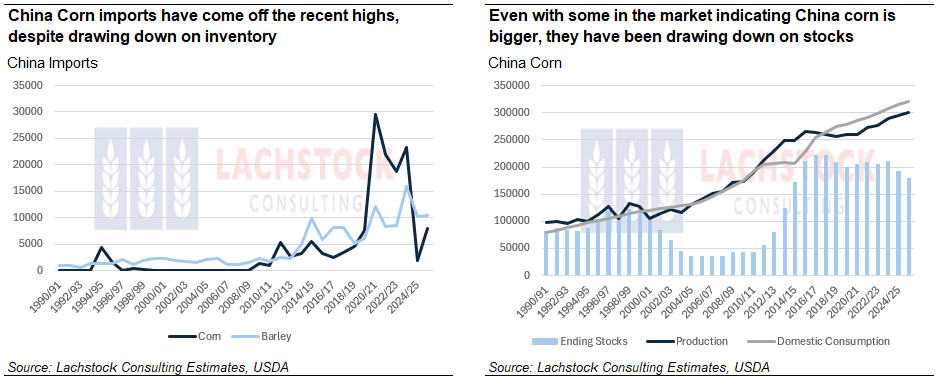
Barley is now at lofty levels vs wheat, particularly ASW9 which may encourage more grower selling. Dec looks solid for wheat exports to China – demand is still quietly ticking away despite all the talk about the supply side.
Wheat
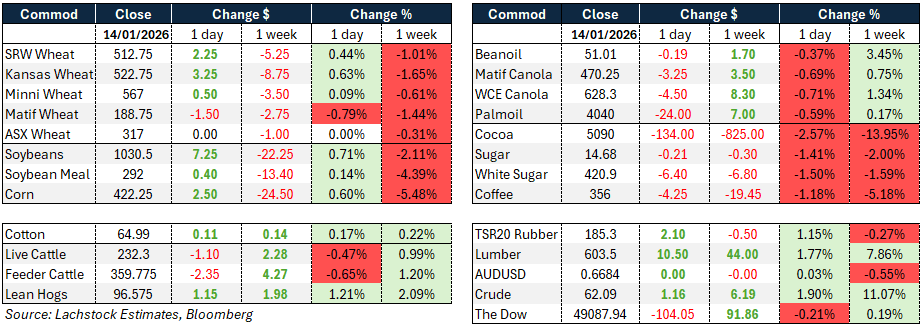
- Chicago +2.25, Kansas +3.25, Matif -1.50
- Wheat futures firmed in the US session, extending a post-WASDE stabilisation as Chicago and Kansas worked back into the middle of recent ranges, while Paris softened with Matif March slipping.
- Spreads in Chicago and KC were mostly firm to flat, Minneapolis calendars weaker, and implied vol eased.
- The tone was supported by weather risk talk rather than fresh demand news.
- SovEcon flagged severe cold risk and ice crusting across parts of the Russian winter wheat belt following an unseasonably warm, wet period, while dryness persists in the US Southern Plains.
- Export focus remains on Russia, with January shipments now seen at 3.0–3.4m tons versus 2.3m a year ago, aided by competitive pricing and stronger importer interest.
- FranceAgriMer left French soft-wheat exports unchanged at 15.1m tons, with a marginal shift toward EU destinations and slightly higher carryout.
- Geopolitics remained an undercurrent, with Black Sea shipping insurance costs rising again and Iran headlines injecting risk premium, though late-day rhetoric was marginally less inflammatory.
- US weekly wheat export sales expectations sit around 275k tons.
Other Grains and Oilseeds
- Corn +2.50, Soybeans +7.25, Matif canola -3.25
- Corn, soybeans and products rebounded after heavy post-WASDE selling, helped by bargain hunting and confirmation of strong nearby usage.
- US corn drew support from relative price competitiveness versus other origins, record ethanol production at 1.196m b/d, and steady export interest, including reported sales to South Korea.
- Stocks rose alongside output, but usage strength muted the negative read.
- Attention turns to CONAB, where Brazil’s corn crop is expected to be revised higher toward 139.9m tons, and to US export sales expectations near 1m tons following last week’s marketing-year low.
- Soybeans held gains with early support from bean oil and later from meal, though crush margins eased.
- Brazil remains the dominant theme, with CONAB likely to lift soybean output to around 179.2m tons and January exports tracking toward record levels despite the harvest only just beginning.
- China’s 2025 soybean imports hit a record 111.8m tons, reinforcing demand resilience, though near-term price outlook remains capped unless South American weather deteriorates later in Jan/Feb.
- In vegoils, Indonesia’s decision to stick with B40 biodiesel eased supply concerns, pressuring palm oil and spilling into broader oilseed sentiment.
Macro
- Aud 0.6684, Dow -104.21, Crude +1.16
- Macro remains a key overlay for ag markets, with risk assets generally supported but volatility elevated.
- US data showed healthy consumption momentum, with November retail sales up 0.6% m/m and control group sales pointing to solid Q4 growth, while PPI indicated no meaningful pipeline inflation pressure.
- Fed commentary leaned cautiously dovish, with officials expressing optimism that inflation is tracking toward 2% on a run-rate basis and suggesting scope for modest rate adjustments later in the year, alongside comments that deregulation could lift productivity and weigh on prices.
- Equity markets absorbed the data positively, while energy was choppy amid geopolitical uncertainty.
- Iran remained a central risk point, with warnings around retaliation against US bases in the region and implications for shipping, insurance, and trade flows, even as late headlines hinted at reduced immediate escalation.
- Trade policy uncertainty also lingered, with tariffs, USMCA rhetoric, and global trade balances feeding into the broader risk narrative.
Local
- Bids were stronger in the west yesterday, with canola pushing back towards the $800 level, bid $795; APW was $320 and strength in barley continued, trading around $320.
- Through the east, bids were $15 higher for canola around $750, wheat was $325 and barley $305 track Geelong. There are still a few small wheat shorts out there, with prompt ASW bid $345–350 into Geelong/Melbourne as grower liquidity remains slow.
- Lentils have rallied $30–40 from recent lows, with Indian buyers re-engaging and bulk shipments now looking to be filled. Weather concerns in Indian lentil regions and the absence of tariffs have buyers back in the market for Australian pulses.
- Interesting to note: Wool passed-in rates have collapsed to sub-1% at the first 2026 auctions as tight Merino supply and steady Chinese demand pushed prices sharply higher, with Merino clips jumping 80–100c/kg and low pipeline stocks now clearly underpinning the market.
Click here to read the full report.